How to Create, Import, and Export Subtitles in Nero Video

Subtitles make your videos easier to follow, more accessible, and more convenient to watch without sound. With Nero Video, you can create subtitles manually, import existing SRT subtitle files, automatically generate subtitles using speech recognition, and export your subtitles for use in other video editing applications.

This guide walks you through all four subtitle workflows, from creating your first subtitle to exporting a finished subtitle file.
1. Create Subtitles Manually

If you want complete control over your subtitle text, timing, and appearance, you can create subtitles directly on the Subtitle track in the Nero Video timeline.
Step 1: Open the Subtitle Track

  1. Open your project in Nero Video and add your video to the timeline.
  2. Locate the Subtitle track in the timeline.
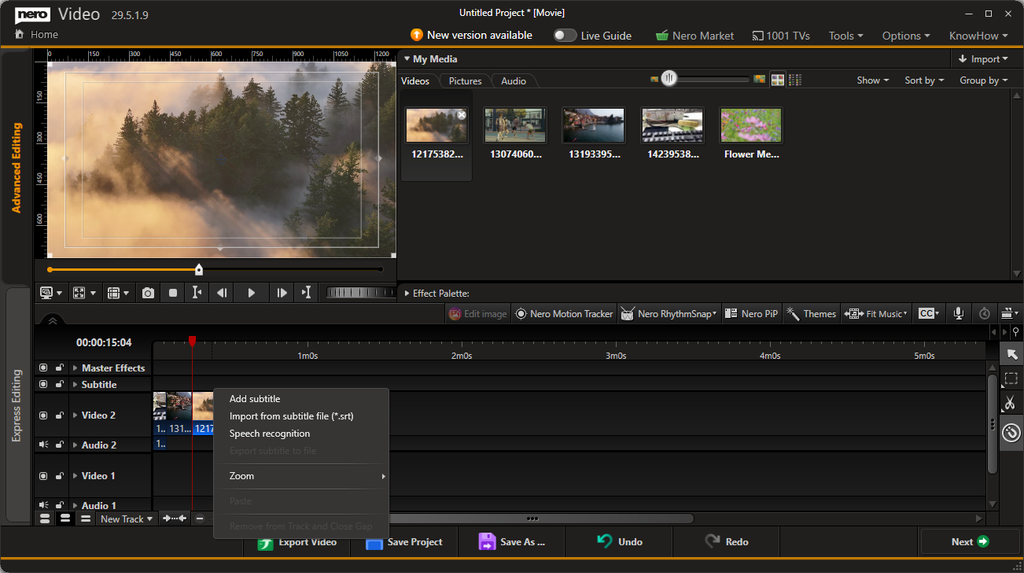
  3. Double-click an empty area on the Subtitle track where you want to add a subtitle.

Alternatively, right-click an empty area on the Subtitle track and select Add subtitle from the context menu.

Step 2: Enter Your Subtitle Text

After creating a subtitle, enter the text you want to display in your video. Use the preview window to check how the subtitle appears over your footage.

Keep your subtitle text concise and easy to read. For longer dialogue, consider splitting the text into multiple subtitle segments.

Step 3: Customize the Subtitle Appearance

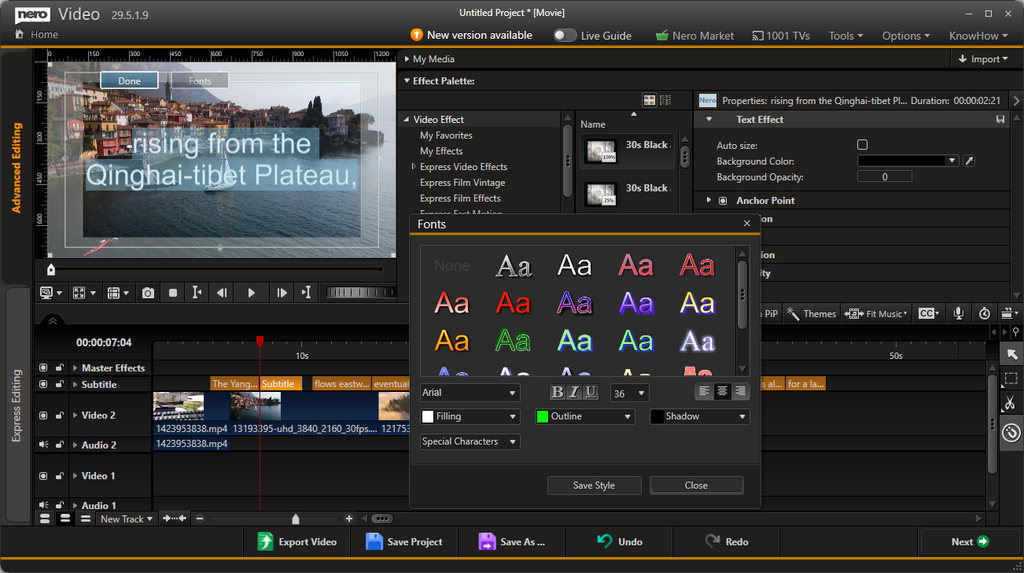
Use the subtitle editing controls to customize the text style. Depending on your needs, you can adjust options such as:

  • Font: Choose a suitable font for your video.
  • Font size: Make the text readable at your intended playback size.
  • Text color and fill: Select a color that contrasts with the video.
  • Outline: Add an outline to help the text stand out against bright or busy backgrounds.
  • Shadow: Apply a shadow to improve readability.
  • Text alignment: Adjust the alignment to suit your composition.

You can also save a customized style for reuse, helping you maintain a consistent look across your subtitles.

Step 4: Check the Subtitle Timing

Review the subtitle on the timeline and preview it during playback. Make sure the text appears at the appropriate moment and remains visible long enough to read.

Repeat these steps to create additional subtitle segments throughout your video.

Tip: Use consistent font sizes, colors, and positioning throughout your project to create a polished and professional result.

2. Import Subtitles from an SRT File

Already have subtitles prepared? Nero Video supports importing subtitles in the SubRip Subtitle (SRT) format, allowing you to reuse existing subtitle text and timing instead of creating every segment manually.

Step 1: Prepare Your SRT File

Make sure your subtitle file uses the .srt file extension and contains the subtitle text and timing information you want to use.

Step 2: Import the Subtitle File

  1. Open your project in Nero Video.
  2. Locate the Subtitle track in the timeline.
  3. Right-click the Subtitle track or an empty area on it.
  4. Select Import from subtitle file (*.srt).
  5. Browse to your SRT file and select it.

Step 3: Review the Imported Subtitles

After importing, check the subtitle segments on the timeline and preview the video.

Verify that the text displays correctly and that the subtitles are synchronized with the dialogue or other relevant audio.

If necessary, adjust the subtitle timing or appearance before exporting your finished video.

Tip: If the subtitles appear out of sync, check the timing information in the SRT file and compare it with the actual video content.

3. Automatically Create Subtitles with Speech Recognition

Don’t have a subtitle file yet? Nero Video can use speech recognition to generate subtitles automatically from spoken audio in your project.

This feature uses online speech recognition services hosted on Nero’s own servers, so an internet connection is required.
Step 1: Open Speech Recognition

  1. Open your video project and locate the Subtitle track.
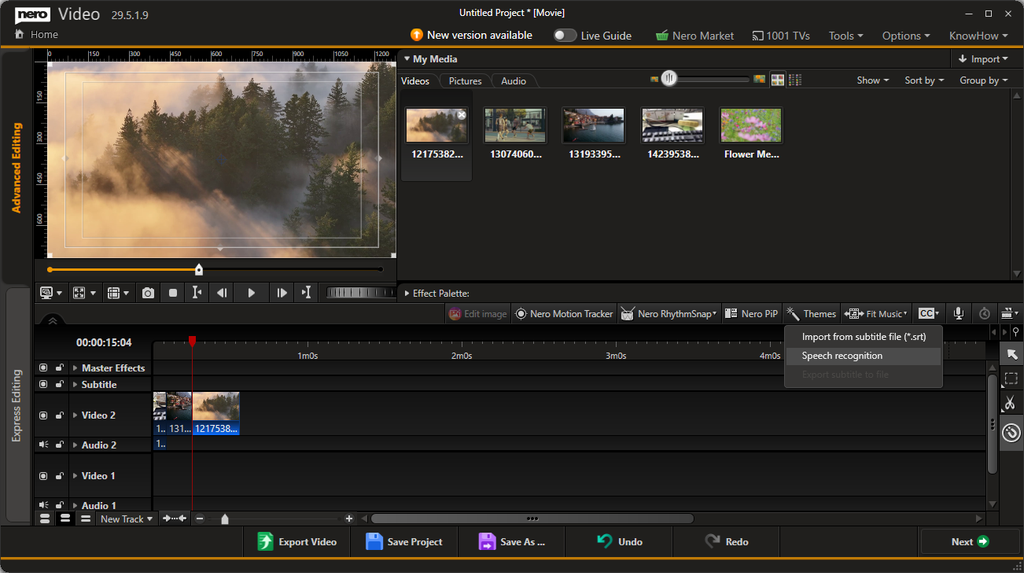
  2. Right-click the track or an empty area on it.
  3. Select Speech recognition from the context menu.

The Speech Recognition dialog opens, allowing you to configure the recognition settings.

Step 2: Select the Audio Track

Under Audio track containing speech, select the audio track that contains the dialogue or narration you want to transcribe.

If your project contains multiple audio tracks, choose the one with the clearest spoken content.

For example, select the track containing the original dialogue rather than a background music track.

Step 3: Choose the Language

Under Language, select the language spoken in your video.

You can leave the setting at Auto when you want Nero Video to detect the language automatically.

For the best results, select the correct language manually when it is known and available.

Step 4: Enable Translation (Optional)

If you want subtitles in another language, select Enable translation.

Then choose the target language from the available language options.

This allows you to generate translated subtitles instead of subtitles only in the original spoken language.

Step 5: Generate the Subtitles

Click Create to start the speech recognition process.

Nero Video processes the selected audio using its online service and generates subtitle segments for your project.

Once the process is complete, review the generated subtitles on the timeline.

Step 6: Review and Correct the Results

Automatic speech recognition can occasionally misinterpret words, names, accents, or background speech. Review the generated text carefully and correct any errors.

Also check the timing and readability of each subtitle segment before exporting your video.

Tips for better results:

  • Use audio with clear speech and minimal background noise.
  • Select the correct audio track.
  • Choose the spoken language when it is known.
  • Review technical terms, proper names, and translated text.
  • Check subtitle synchronization during playback.

4. Export Subtitles as an SRT File

Need to reuse your subtitles in another video editor, share them separately, or keep them as a standalone file? Nero Video lets you export subtitles in SRT format.

Step 1: Open the Subtitle Track Menu

After creating or importing subtitles, locate the Subtitle track in the timeline.

Right-click the track or an empty area on it to open the context menu.

Step 2: Export the Subtitle File

Select Export subtitle to file from the context menu.

Follow the prompts to save the subtitle file in SRT format at your preferred location.

Step 3: Reuse Your SRT File

Your exported SRT file can be stored separately from the video and imported into compatible video editors or playback applications.

Before sharing the file, check that the subtitle text and timing match the intended video.

Export Subtitles or Export the Video?

These are two different operations:

  • Export subtitle to file: Creates a separate subtitle file in SRT format.
  • Export Video: Renders your video into a video file. In the Export Video window, the Export subtitle to file checkbox is a separate option for exporting the subtitles alongside the video export workflow.

If you need a standalone subtitle file for another application, use the Subtitle track’s context menu.

Frequently Asked Questions

1. Can I create subtitles without an existing subtitle file?

Yes. You can create subtitles manually by double-clicking an empty area on the Subtitle track or selecting Add subtitle from its context menu. You can also use speech recognition to generate subtitles from spoken audio.

2. What subtitle file format does Nero Video support for importing and exporting?

The subtitle import and export workflows described in this guide use the SubRip Subtitle format (.srt).

3. Can Nero Video generate subtitles automatically?

Yes. Select Speech recognition from the Subtitle track’s context menu. Choose the audio track containing speech and the language, then click Create.

4. Does speech recognition require an internet connection?

Yes. Nero Video’s speech recognition feature uses online services hosted on Nero’s own servers, so an internet connection is required to generate subtitles.

5. Can I translate subtitles into another language?

Yes. In the Speech Recognition dialog, enable Enable translation and select the target language from the available options. Review the translated subtitles after generation to ensure their accuracy.

6. Can I edit subtitles generated by speech recognition?

Yes. Treat automatically generated subtitles as a starting point. Review the text, correct recognition errors, and check the timing and appearance before finishing your project.

7. Can I customize the appearance of my subtitles?

Yes. Nero Video provides subtitle styling controls, including font selection, font size, fill color, outline, shadow, and text alignment. You can also save a custom style for reuse.

8. Can I export subtitles without exporting the video?

Yes. Right-click the Subtitle track and select Export subtitle to file to save a standalone SRT file. You do not need to render the entire video just to obtain a separate subtitle file.

9. Why can’t I select Export subtitle to file?

Make sure your project contains subtitles on the Subtitle track and that you are opening the correct track context menu. If the option is unavailable, check whether subtitles have been created or imported successfully.

10. Can I use an SRT file in another video editor?

Yes. SRT is a widely supported subtitle format. You can import the exported file into compatible video editing applications and media players. Subtitle styling may need to be configured again in the destination application.

11. Why are my subtitles out of sync with the video?

The subtitle timing may not match the video’s dialogue or the SRT file may have been prepared for a different version of the video. Check the timing of the subtitle segments and adjust them to match the footage.

12. Why does speech recognition produce incorrect words?

Recognition accuracy depends on audio clarity, background noise, accents, pronunciation, and the selected language. Select the correct audio track, reduce background noise where possible, and review the generated text before exporting.

Conclusion

Nero Video gives you four practical ways to work with subtitles: create them manually, import existing SRT files, generate them automatically through speech recognition, and export them as standalone SRT files.

Whether you’re editing dialogue, preparing translated subtitles, or creating captions for a video project, these tools help you manage subtitles within your existing editing workflow.
Keep Your Cloud Storage Clean and Organized with TuneItup 4.1.0.0

Meet Cloud Manager

Managing files across multiple cloud storage services can be a challenge. Over time, unnecessary files and duplicates can take up valuable storage space and make it harder to find what you need.

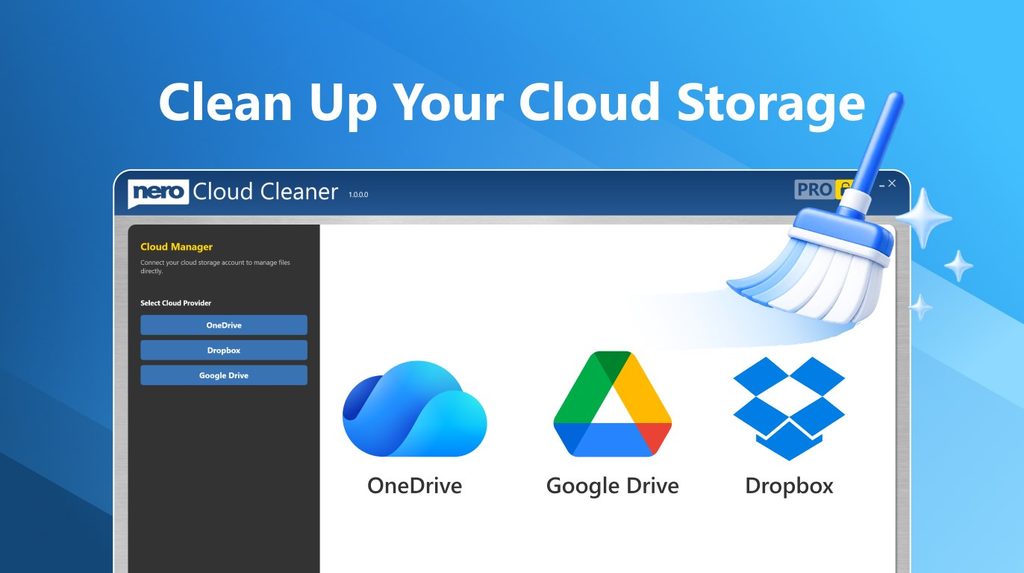
With Nero TuneItUp 4.1.0.0, we’re introducing Cloud Manager, a new feature designed to help you clean up and organize your cloud storage more easily.

☁️ Clean Up Your Cloud Storage

Cloud Manager helps you identify unnecessary files and duplicate files in your connected cloud storage, making it easier to free up space and keep your files organized.

🔗 Manage Multiple Cloud Services

Cloud Manager supports three popular cloud storage services:

  • Dropbox
  • OneDrive
  • Google Drive

Manage your cloud storage more efficiently in one convenient place, without the hassle of checking each service separately.

✨ Explore Cloud Manager Features

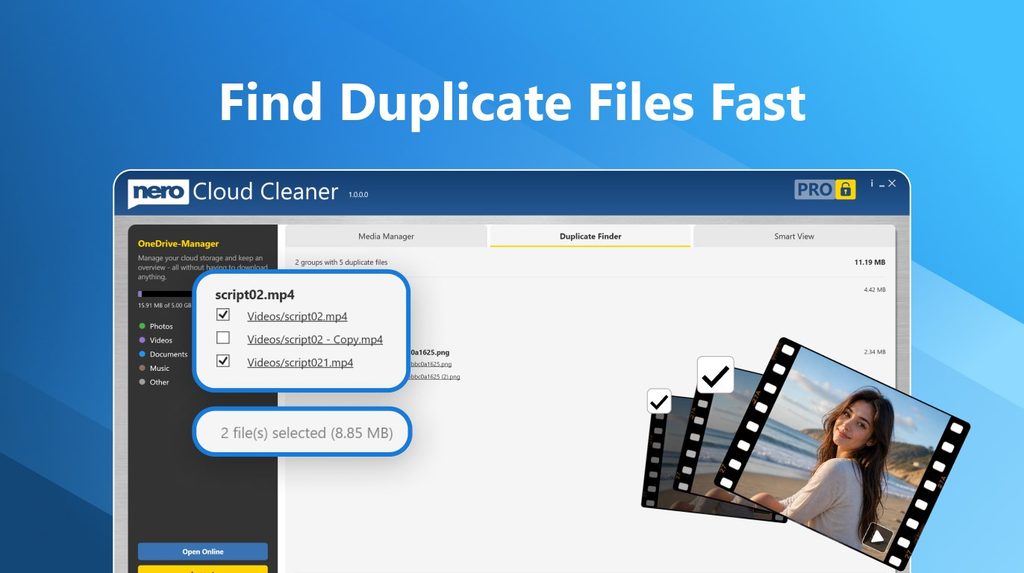
  • Find Duplicate Files
    Scan photos, videos, music, documents, and other files to identify duplicate copies that take up valuable cloud storage space.
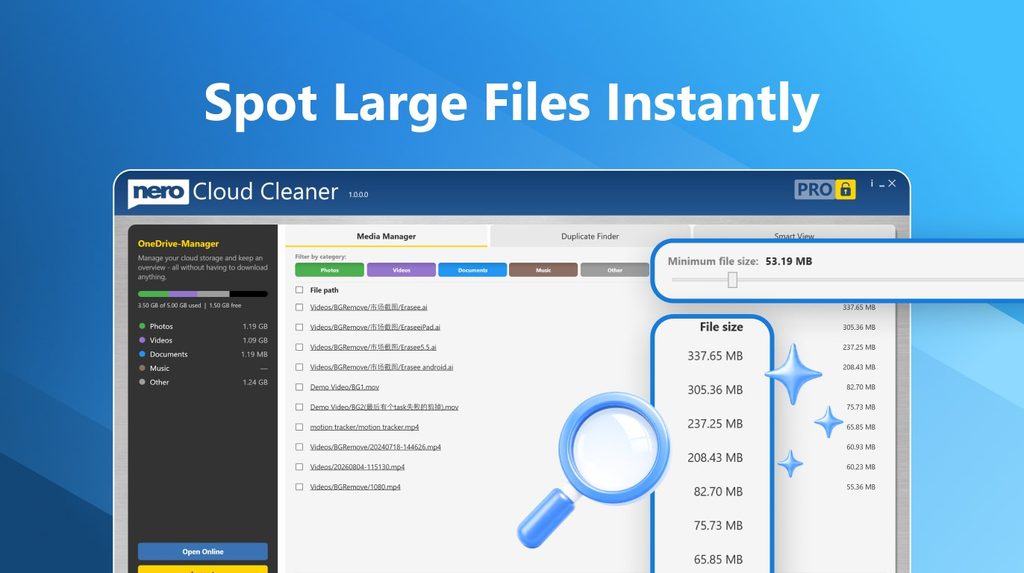
  • Spot Large Files Quickly
    Filter files by size to find storage-heavy items without manually browsing through folders.
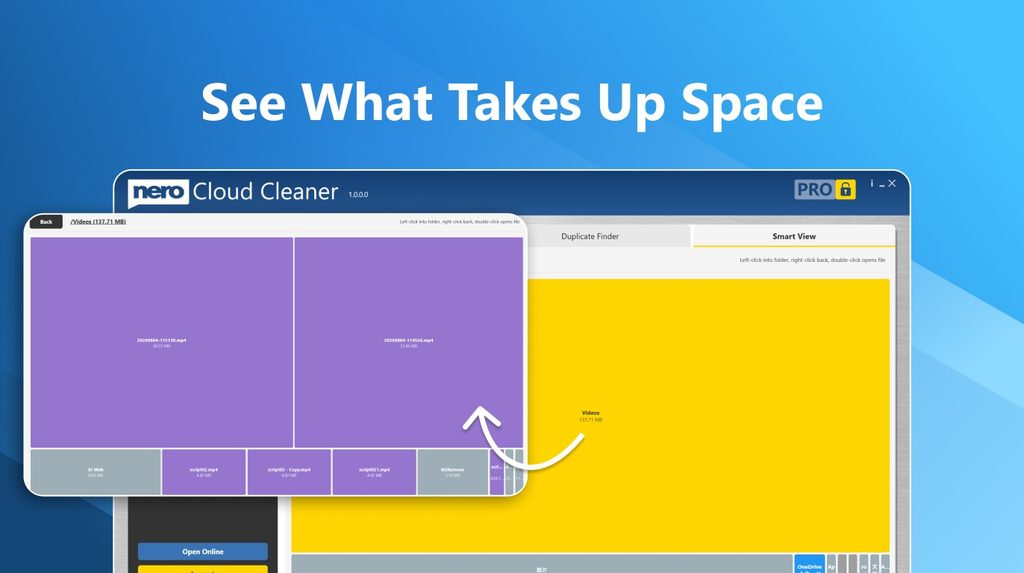
  • Understand Your Storage at a Glance
    Use Smart View to visualize how your files are distributed and see which categories use the most storage space.
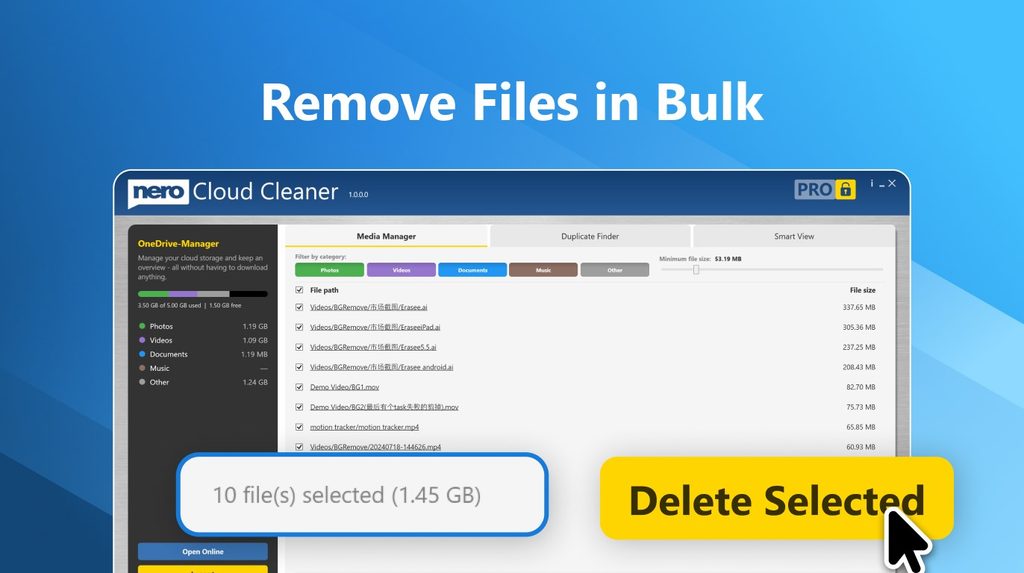
  • Remove Files in Batches
    Select multiple unwanted files and delete them together for faster, more efficient cloud storage cleanup.

🛠️ How to Use Cloud Manager

  1. Sign In to Your Cloud Account
    Sign in to the cloud storage account you want to manage.
  2. Find Files to Clean Up
    Open Media File Analysis and filter files by size to find large files, or run a Duplicate File Scan to identify duplicate copies.
  3. Select Files to Delete
    Select the files you no longer need and delete them in batches to free up cloud storage space.
  4. Restore Files if Needed
    Accidentally deleted a file? Open your cloud provider’s Trash or Recycle Bin to restore it, subject to the provider’s retention policies.

Update to the latest version and discover Cloud Manager today!

How to digitize your CD collection faster with Nero Burning ROM?

If you have a large collection of audio CDs, Nero Burning ROM can help you digitize them with fewer manual steps while keeping your music files organized.

With Collection Ripping and Custom File Naming, you can:

  • Automate repetitive steps — start ripping automatically, select Gracenote album information, and eject finished discs.
  • Step away while ripping — return when a disc is finished and you hear the sound notification.
  • Track ripping results — use session reports to review ripping status and errors.
  • Match your existing music library — customize file names using your preferred metadata fields, order, and separators.

1. How to start ripping an Audio CD

To get started, open Nero Burning ROM and access the Audio CD ripping feature using either of these methods:

Option 1: From the toolbar

Click Rip in the top toolbar.

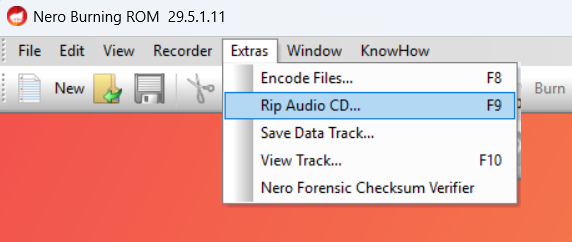
Option 2: From the menu

Go to Extras > Rip Audio CD…

Both options open the Nero CD Ripper window, where you can configure Collection Ripping and Custom File Naming before digitizing your CDs.

2. Set up Collection Ripping for multiple CDs

Collection Ripping automates steps that previously required repeated clicks, including starting each rip, selecting Gracenote album information, and ejecting finished discs.

How to enable Collection Ripping

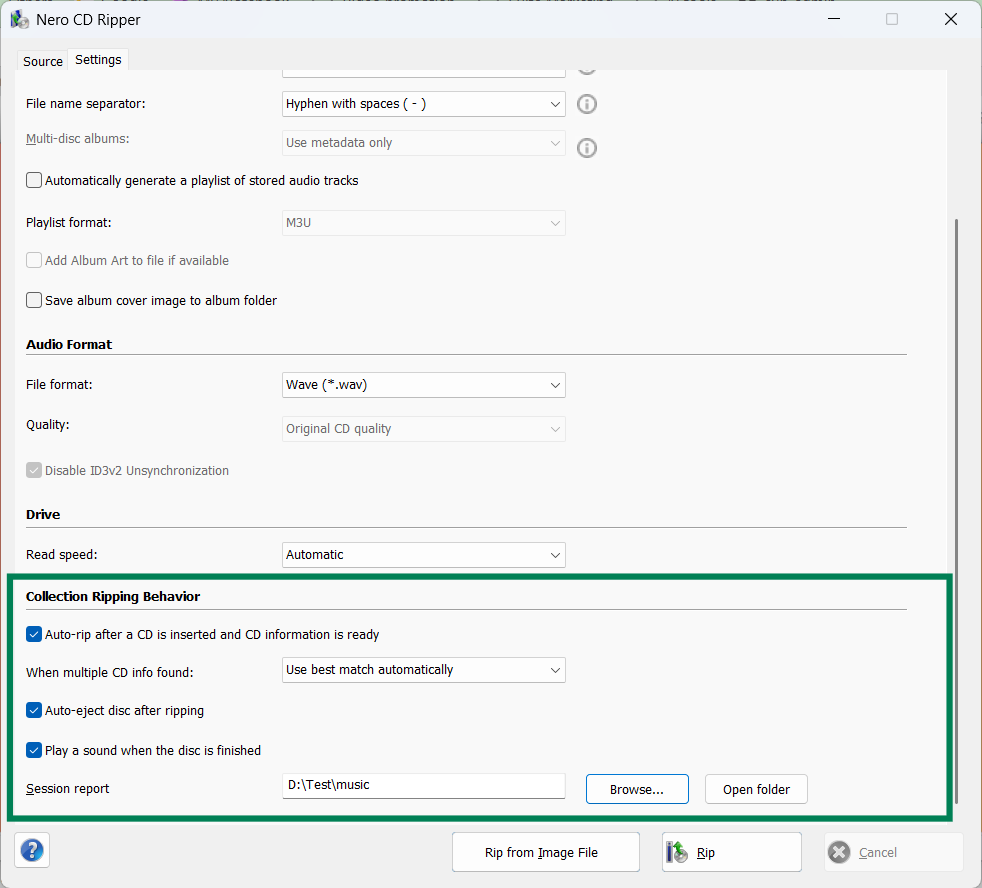
  1. In the Nero CD Ripper window, switch to Settings, find Collection Ripping Behavior.
  2. Enable Automatically start ripping after album and track information is ready.
  3. Under When multiple CD info found, choose:
    • Use best match automatically — Nero selects the best available Gracenote album information and starts ripping without asking.
    • Ask me to choose — select the correct album information yourself when multiple matches are found.
  4. Enable Auto-eject disc after ripping.
  5. Enable Play a sound when the disc is finished.
  6. Optionally, select a folder for the Session report to keep a record of ripping results and errors.

How does it work?

With automatic ripping, auto-eject, and sound notifications enabled:

  1. Insert an audio CD. Nero retrieves the album and track information from Gracenote.
  2. Ripping starts automatically when the information is ready. If multiple matches are found, Nero follows your selected matching preference.
  3. You can step away while Nero processes the CD.
  4. When finished, Nero ejects the disc and plays a notification sound.
  5. Insert the next CD to continue.

You still need to change discs manually, but you no longer need to monitor the ripping process or repeatedly click Rip and Eject.

Tip: Choose Use best match automatically for fewer interruptions. If multiple album matches are found and you prefer to verify the information, select Ask me to choose.

3. Customize file names to match your music library

If you already have a digital music collection, you may want newly ripped files to follow the same naming conventions.

With Custom File Naming, you can define how metadata is combined in file names, rather than relying on preset formats or manually renaming files after ripping.

How to customize file naming

  1. In the Nero CD Ripper window, switch to Settings, find the file naming settings.
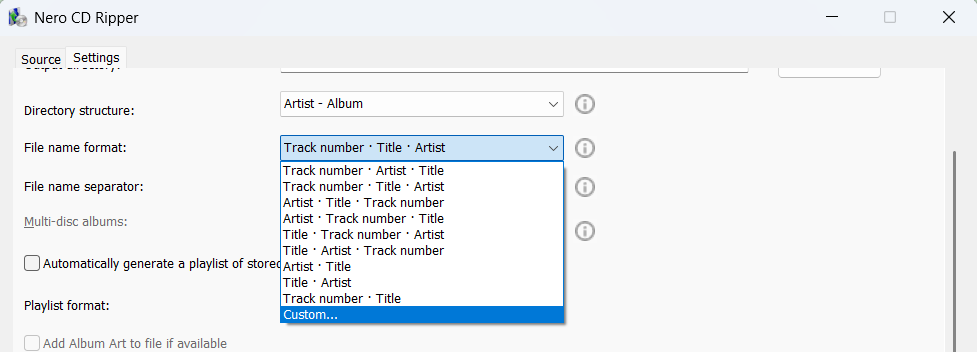
  2. Under File name format, select Custom…
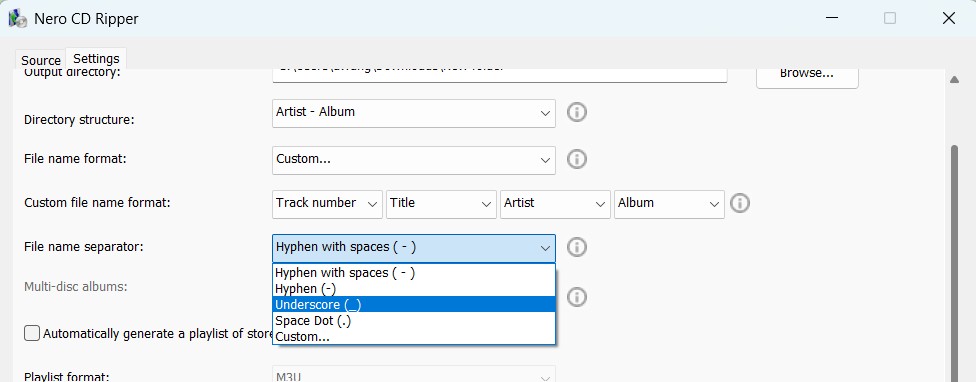
  3. Under Custom file name format, select the metadata fields you want, such as Artist, Album, Title, or Track Number.
  4. Arrange the fields in your preferred order.
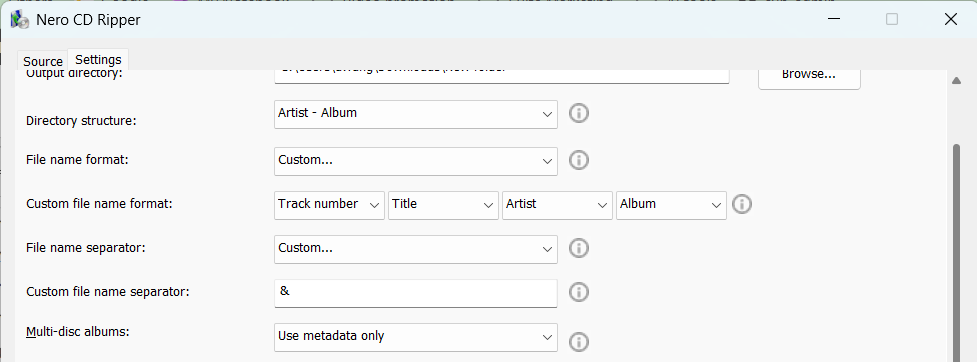
  5. Under File name separator, choose a separator such as - or _, or select Custom… to enter your own.
  6. Start ripping. Nero will apply your naming format to the output files.

Example: Match your existing file naming style

Suppose you’re ripping a track with this information:

  • Artist: Queen
  • Album: A Night at the Opera
  • Title: Bohemian Rhapsody
  • Track Number: 11

You can choose a format that matches your existing music library:

File naming formatExample output
Artist – TitleQueen – Bohemian Rhapsody.mp3
Track Number – Title11 – Bohemian Rhapsody.mp3
Artist – Album – TitleQueen – A Night at the Opera – Bohemian Rhapsody.mp3
Artist_Album_TitleQueen_A Night at the Opera_Bohemian Rhapsody.mp3

You can combine metadata fields in different orders and use your preferred separators.

Tip: Configure file naming before ripping a large collection to keep your new files consistent with your existing library and avoid renaming them afterward.


Quick tip

For large CD collections, enable automatic ripping, auto-eject, and sound notifications together. This lets you step away during each rip and return when the next CD needs to be inserted.

Set your custom file naming format beforehand so the resulting files are organized consistently from the start.

Browse your media your way with Folder view

What is Folder view in Nero MediaHome?

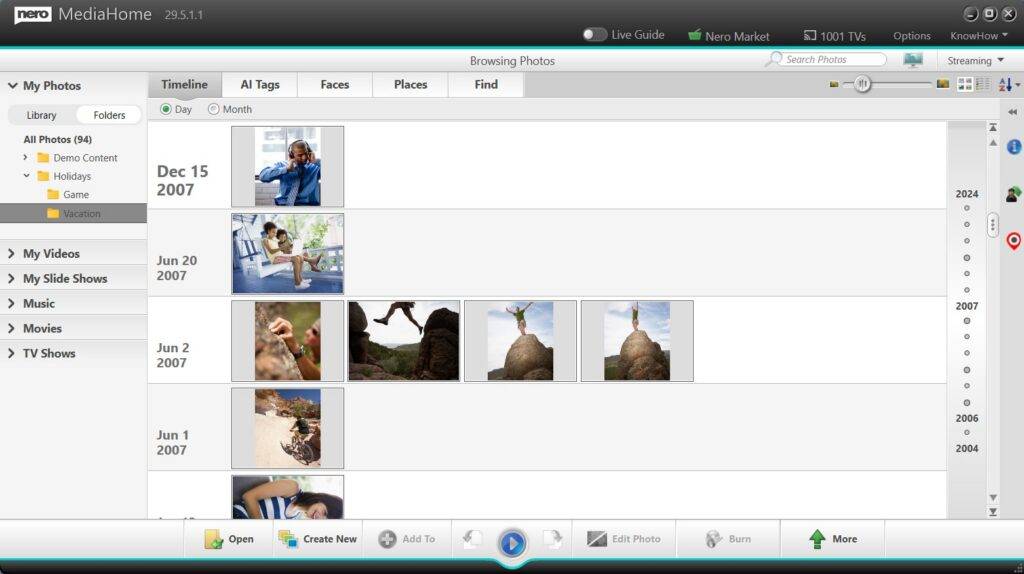
Folder view gives you another way to browse your photos and videos in Nero MediaHome.

Instead of browsing only through the MediaHome Library, you can now view your media using the folder structure you already know from Windows.

Switch between:

  • Library — browse media organized by Nero MediaHome.
  • Folders — browse media using your existing folders and subfolders.

Both views work with the same media. You can switch between them anytime depending on how you want to find your photos or videos.


Why use Folder view?

Many people already organize their photos and videos into folders such as:

Photos > 2026 > Summer Vacation
Videos > Family > Birthdays

With Folder view, you don’t need to learn a different organization just to find them in Nero MediaHome.

It helps you:

  • Find media where you expect it — browse using your familiar Windows folder structure.
  • Keep your existing organization — there is no need to reorganize or move your files.
  • Switch browsing styles anytime — use Folders when you know where a file is, or Library when you want MediaHome to help you explore your collection.
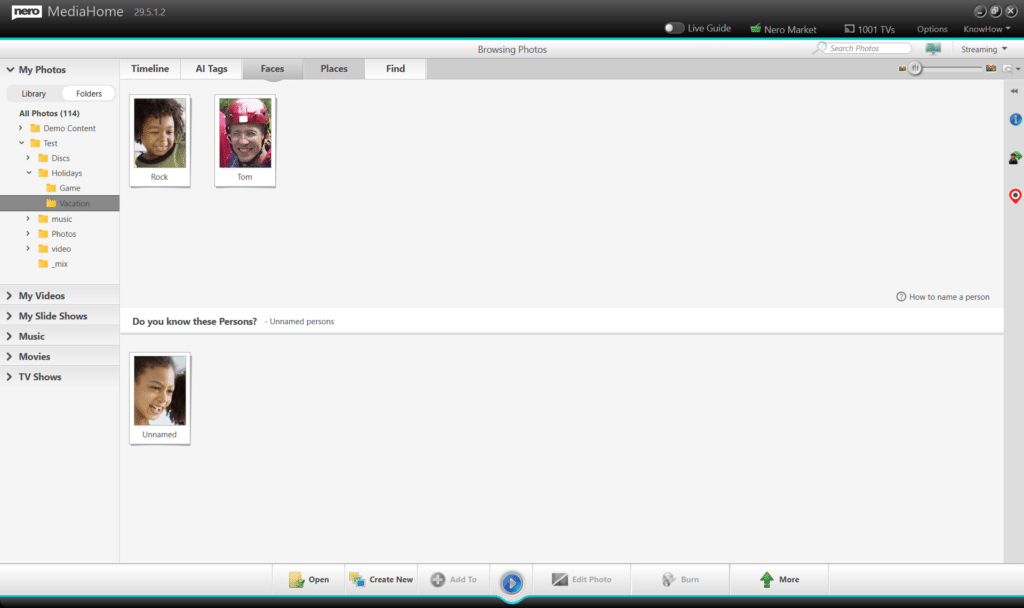
  • Combine folders with smart media information — find files by folder first, then use MediaHome information such as Faces, Places and AI tags to explore related memories.

How do I browse my media by folder?

  1. Open Nero MediaHome.
  2. Go to My Photos or My Videos.
  3. Select Folders instead of Library.
  4. Browse through your folders and subfolders just as you would in Windows.
  5. Select a folder to see the photos or videos it contains.

You can switch back to Library at any time.

Switching views does not move, rename, or reorganize your original files and folders.


How do Folders work with Faces, Places and AI Tags?

This is where Folder view becomes especially useful.

Your folder structure tells you where you stored your media, while Nero MediaHome’s smart information helps you find and explore media based on who or what is in it, and where it was taken.

For example, suppose you open:

Photos > 2026 > Summer Vacation

You can browse the photos exactly where you saved them, while Nero MediaHome can still use smart information such as:

  • Faces — find and organize photos by the people in them.
  • Places — explore photos based on where they were taken.
  • AI Tags — automatically identify content in your photos, making it easier to find images by subjects and objects.

This gives you complementary ways to find your media:

Folders: Where did I save it?
Faces: Who is in it?
Places: Where was it taken?
AI Tags: What is in it?

You don’t have to choose one way of organizing your media. Use them together depending on what you remember about the photo you’re looking for.


When should I use Library or Folders?

If you want to…Use
Browse media using your existing Windows organizationFolders
Go directly to a folder you already knowFolders
Browse your media through MediaHome’s organizationLibrary
Explore memories by people or locationFaces / Places
Find related media when you don’t remember where it is storedLibrary + Faces / Places

Quick tip

You don’t need to reorganize your media to take advantage of Nero MediaHome.

Keep the folder structure that already works for you, and use MediaHome’s Faces and Places when you want a smarter way to explore your collection.