Users who activate a Nero subscription while the same product is already active in their Nero Account.
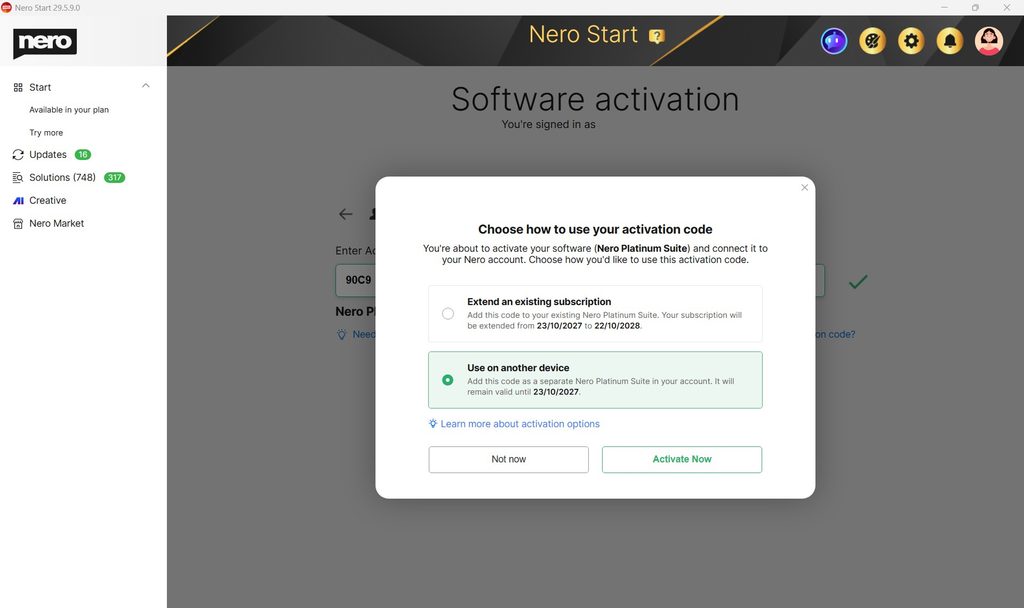
Why am I seeing this dialog?
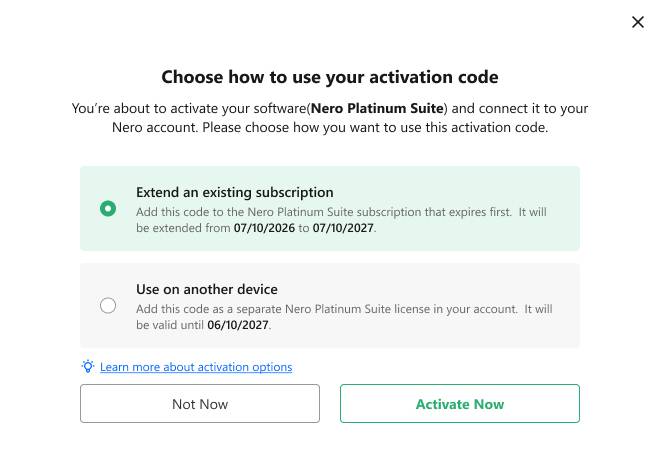
You’re activating a product that is already available in your Nero Account.
Instead of automatically extending your existing subscription, Nero Start now lets you choose how you would like to use your new activation code.
You have two options:
Extend an existing subscription
Use on another device
Option 1: Extend an existing subscription
Choose this option if you want to extend your current subscription.
Your activation code will be added to one of your existing subscriptions, and the expiration date will be extended.
For example:
Current subscription:
Expires: July 10, 2026
After activation:
Expires: July 10, 2027
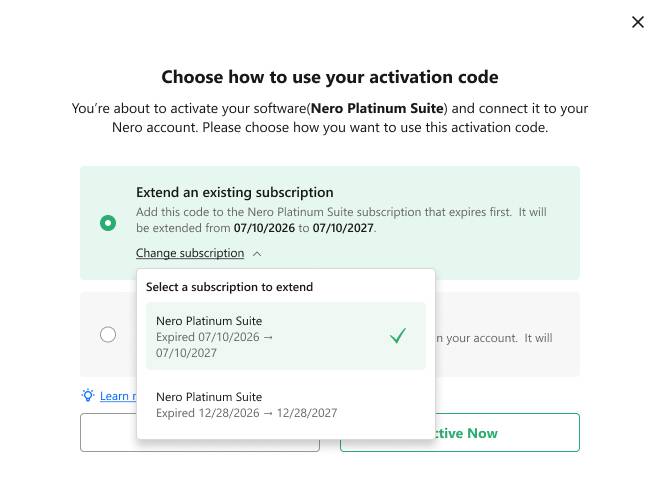
If your account contains multiple subscriptions for the same product, Nero Start selects the subscription that expires first by default. You can also select a different subscription by choosing Change subscription.
Best for:
You want to continue using the same subscription.
You don’t need another product license.
You want to extend your subscription period.
Option 2: Use on another device
Choose this option if you want to create a separate product license.
Your activation code will become a new subscription in your Nero Account instead of extending an existing one.
Since most Nero products are licensed for 1 PC per license, this option is useful if you want to use the product on another PC.
For example:
Your account currently contains:
Nero Platinum Suite (expires July 10, 2026)
After choosing Use on another device:
Nero Platinum Suite (expires July 10, 2026)
Nero Platinum Suite (expires July 10, 2027)
Each subscription can be used on its own licensed PC.
Best for:
You want to use Nero on another PC.
Another family member or colleague will use a separate license.
You don’t want to extend your current subscription.
Which option should I choose?
If you want to…
Choose…
Continue using the same license for a longer time
Extend an existing subscription
Create another license for a different PC
Use on another device
Can I change my choice later?
No.
Once the activation code has been used, the selected option cannot be changed.
Please review your choice carefully before selecting Activate Now.
Nero Start introduces new ways to find the right tools, access your recent work, and manage your Nero products more easily.
Here’s what’s new and improved.
1. Get things done faster with Nero Quick Actions
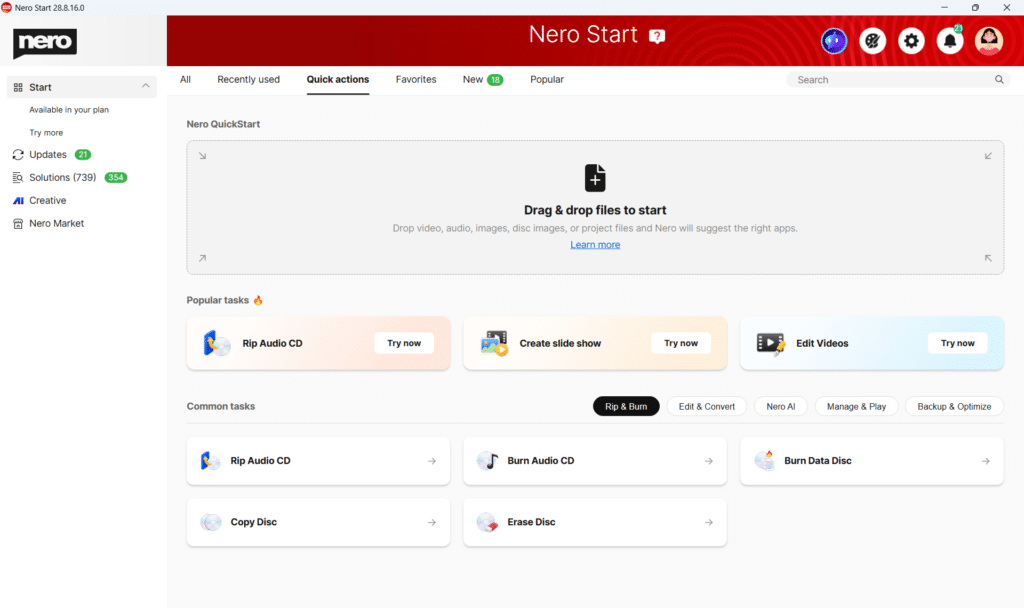
Not sure which Nero app to use for a particular task? Nero Quick Actions helps you get started without searching through different applications.
You can start in two ways:
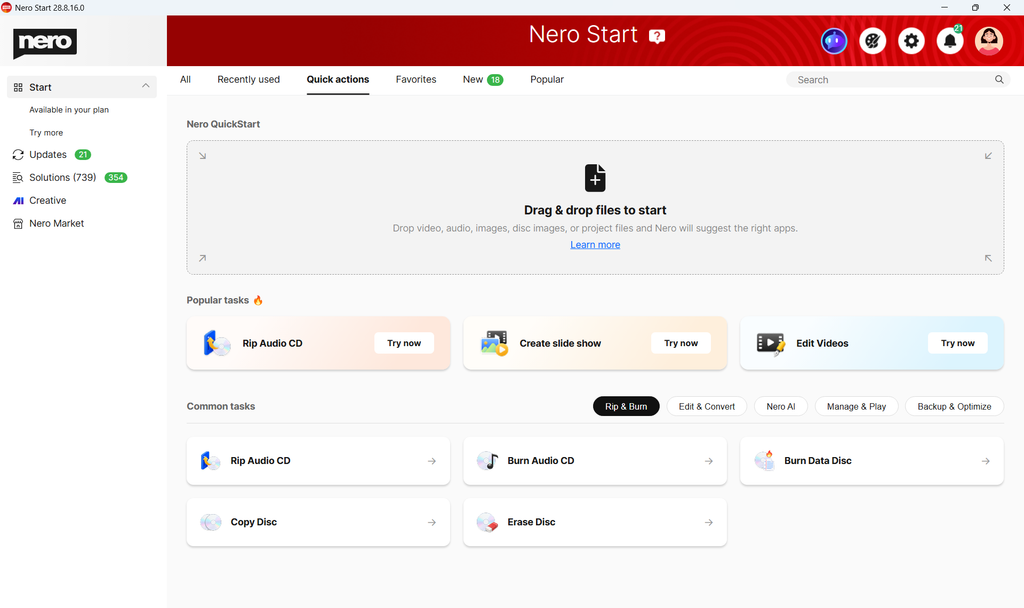
Drag and drop your files: Drop videos, photos, audio files, or other supported files into Quick Actions. Nero Start suggests relevant actions and applications.
Choose a task: Browse common tasks, such as burning discs, converting media, or working with AI tools, and select what you want to do.
Nero Start guides you to the appropriate application. If the required app isn’t installed or available with your current license, it can help you find installation or upgrade options.
Tip: Use Quick Actions when you know what you want to do but aren’t sure which Nero application to open.
2. Find apps and services more easily with the new navigation
Nero Start 2027 introduces Creative and Market sections to help you explore Nero’s tools and services.
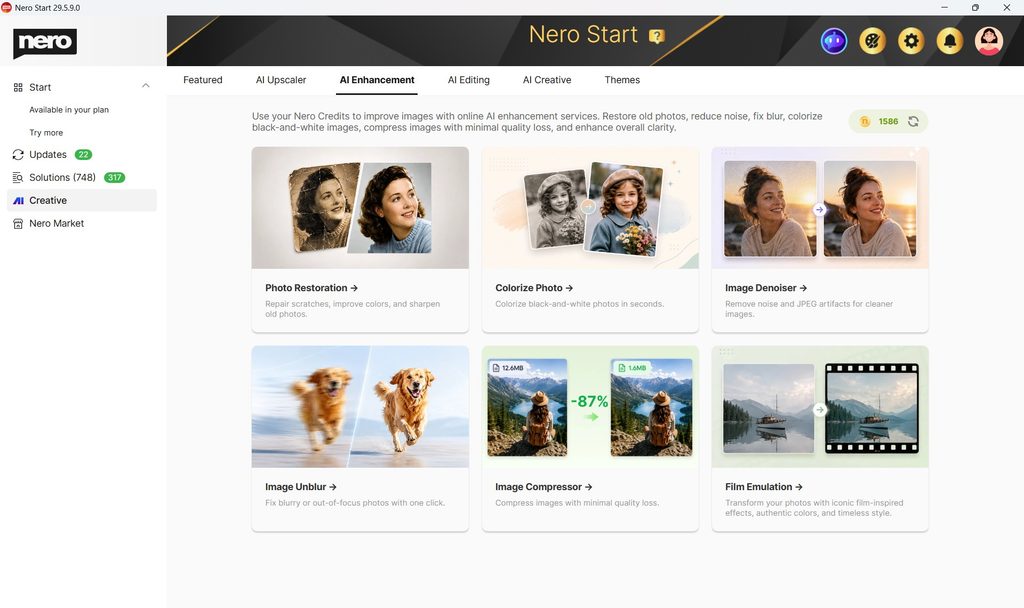
Creative: Discover Nero’s AI-powered creative tools and online services.
Market: Browse Nero applications or products on other channels, and available VIP offers.
These sections make it easier to find what you need without browsing through unrelated applications or features.
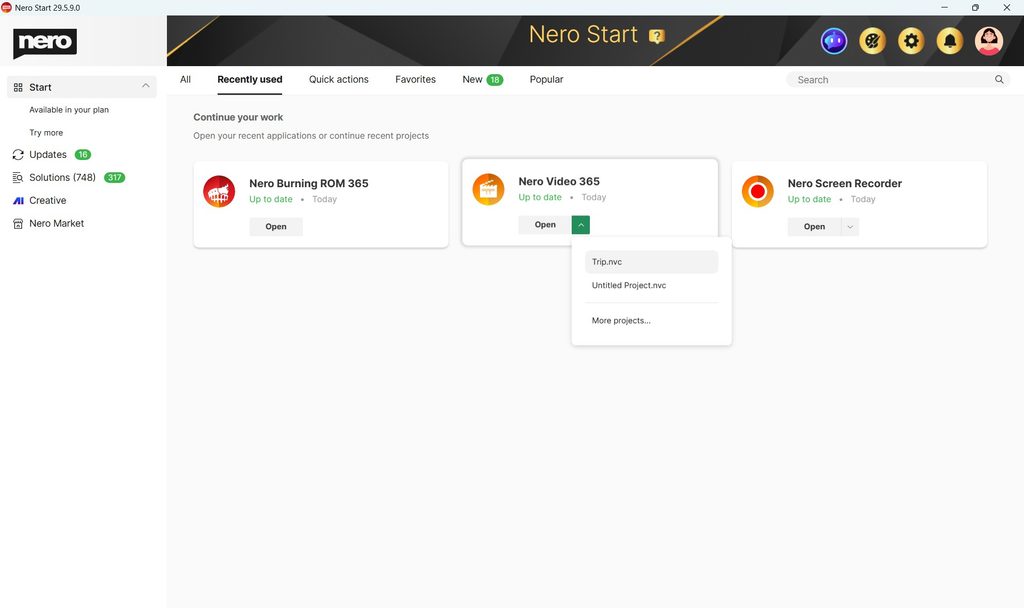
3. Continue your work with Recently used
Need to reopen a project or file you’ve worked on before?
The improved Recently used section provides quick access to your recent projects and files directly from Nero Start.
Open Nero Start.
Find the Recently used section.
Select a recent project or file to open it in the corresponding application.
Tip: Recently used is especially helpful when you’re working on the same media project over multiple sessions.
4. Activate and extend your Nero products more smoothly
If you purchased a Nero product from an offline retailer and received an activation code, Nero Start 2027 makes activation easier, especially if your Nero Account already contains a subscription to the same product.
You can choose to activate the product for another device or extend your existing subscription. The improved process also helps you manage activation when you have multiple licenses for the same product.
Nero Quick Actions helps you start common media tasks without first figuring out which Nero application to use.
Go to Nero Start > Quick Actions and either:
Drag and drop your files — Nero analyzes the file type and suggests suitable apps and actions.
Choose a task — select what you want to do, such as rip an audio CD, burn a disc, create a slideshow, or edit a video.
QuickStart then guides you to the right Nero application for the job.
Why use Quick Actions?
If you have several Nero applications installed, you may know what you want to do, but not necessarily which app you need.
Quick Actions makes this easier:
Start with your task, not the app — tell Nero what you want to do and let it find the right tool.
Save time — launch common tasks directly from Nero Start.
Discover what Nero can do — browse tasks by category and find useful features you may not have used before.
Get the right app — if a required Nero app is not installed yet, Nero Start can guide you to install it.
Start with your files
Already have the files you want to work with?
Open Nero Start > Quick actions.
Drag your video, audio, image, disc image, or supported project file into the Drag & drop files to start area.
Nero QuickStart checks your files and shows suitable actions.
Choose what you want to do.
Nero Start opens the appropriate Nero application so you can continue.
For example, drop a video file to quickly find options for editing, converting, playing, or enhancing it.
Start with a task in Quick Actions
You don’t need to add files first.
Under Popular tasks and Common tasks, simply select what you want to do.
You can browse categories such as:
Rip & Burn · Edit & Convert · Nero AI · Manage & Play · Backup & Optimize
Select a task such as Rip Audio CD, Burn Data Disc, Create slide show, or Edit Videos, and Nero Start will take you to the appropriate Nero application.
What if the required Nero app is not installed?
QuickStart can also recognize when the Nero application needed for a task is not currently installed.
In this case, Nero Start will guide you to install the required app before you continue.
If the required application is not included in your current Nero product, Nero Start may show you an available upgrade option.
Quick tip
You don’t need to remember which Nero application handles each file type or task.
Just start with your files or what you want to do — QuickStart helps you find the right way forward.
When ripping a DVD with Nero Recode, you may want to keep the original subtitles without permanently embedding them in the video. With the external SUB/IDX subtitle export option, you can save selected DVD subtitle tracks separately from the video, giving you more flexibility when watching your ripped movies.
This guide explains how to select DVD subtitles, export them as external SUB/IDX files, and troubleshoot common issues.
What Are External SUB/IDX Subtitles?
SUB/IDX is a subtitle format commonly used for DVD-style image-based subtitles. Unlike text-based formats such as SRT, these subtitles preserve the original subtitle appearance as images, including styling and positioning.
The format consists of two companion files:
SUB file (.sub): Contains the subtitle image data.
IDX file (.idx): Contains subtitle index information, including timing and information needed to select and display the subtitles.
Both files are needed for proper playback. Keep them together and use a compatible media player.
Exporting subtitles separately allows you to retain the subtitle track without burning the subtitles directly into the video image.
How to Export SUB/IDX Subtitles in Nero Recode
Follow these steps to export subtitles while ripping a DVD.
Step 1: Import Your DVD
Launch Nero Recode.
Import the DVD you want to rip.
Select the title you want to convert.
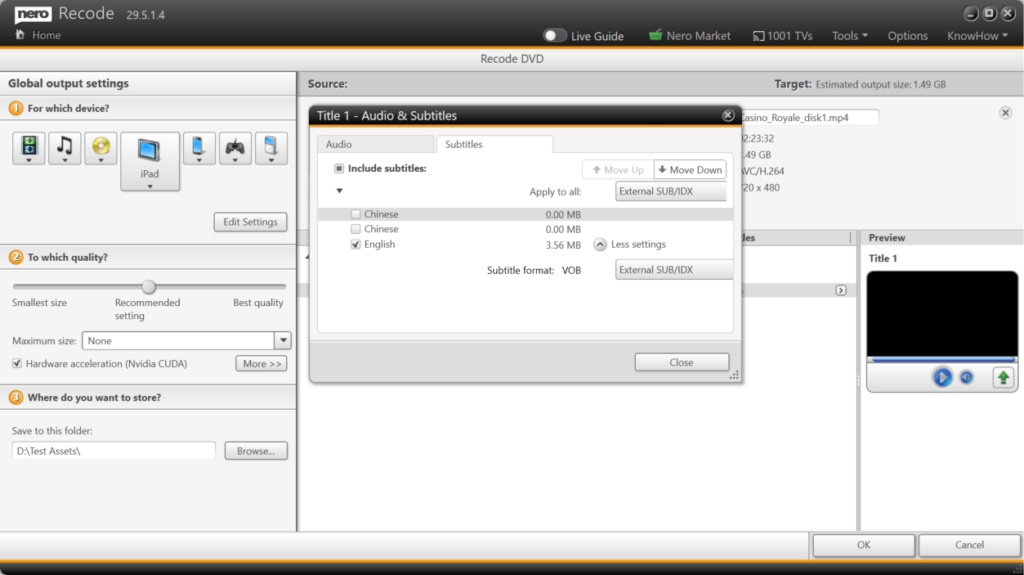
Open the title’s Audio & Subtitles settings.
Nero Recode displays the available audio and subtitle tracks for the selected title.
Step 2: Open the Subtitles Tab
In the Audio & Subtitles window, select the Subtitles tab.
Enable Include subtitles to include subtitle tracks in your output settings. The available subtitle tracks are listed with their language names and, where applicable, their estimated sizes.
Step 3: Select the Subtitle Tracks You Need
Select the checkbox next to each subtitle track you want to export.
For example, if the DVD contains Chinese and English subtitles, you can select English only or choose both languages if you want to keep multiple subtitle options.
Consider the following when choosing your tracks:
Select the language you intend to use during playback.
Keep multiple languages if you need them for different viewers.
Check the estimated size of each track when managing storage space.
Step 4: Choose External SUB/IDX as the Subtitle Format
Locate the Subtitle format setting and select External SUB/IDX.
If you want to apply this setting to multiple titles, use the Apply to all control where available and choose External SUB/IDX for the subtitle format.
This setting tells Nero Recode to export the selected DVD subtitles as external SUB/IDX files instead of relying on subtitles being permanently embedded in the video.
Tip: Confirm the format for the selected subtitle track before proceeding. If your DVD contains several titles, check that the intended subtitle settings apply to each relevant title.
Step 5: Configure the Output and Start Ripping
Close the Audio & Subtitles settings window.
Review the output device, quality, maximum size, and destination folder.
Confirm your selections.
Click OK to start the ripping or conversion process.
When processing is complete, open the output folder and check for the exported subtitle files.
For each exported subtitle track, look for the corresponding .sub and .idx files. Keep both files together with clear, matching filenames so that you can identify the correct subtitle track later.
Step 6: Test the Exported Subtitles
Open the converted video in a media player that supports external SUB/IDX subtitles.
If the subtitles do not appear automatically, use the player’s subtitle menu to load the corresponding IDX file. Confirm that the subtitles display correctly and remain synchronized with the video.
Why Export Subtitles Separately?
External subtitles are useful when you want more control over how you watch your videos.
Flexible playback: Turn subtitles on or off in a compatible player.
Multilingual viewing: Keep separate subtitle tracks for different languages.
Preserved appearance: Retain image-based DVD subtitle styling and positioning.
Cleaner video output: Avoid permanently burning subtitles into the video when a separate subtitle track is preferred.
Reusable subtitle files: Keep subtitle files alongside the video for later playback on compatible devices and applications.
Keep in mind that subtitle support varies by media player and device. Not every player supports SUB/IDX files.
Frequently Asked Questions
1. What is the difference between SUB/IDX and SRT?
SUB/IDX is an image-based subtitle format commonly used for DVD subtitles. SRT is a text-based format that stores subtitle text and timestamps.
SUB/IDX is useful when preserving the appearance of DVD subtitles is important. SRT is generally more convenient when you want to edit subtitle text or use it with a wide range of applications.
2. Why are there two subtitle files, .sub and .idx?
The two files contain different parts of the subtitle information. The SUB file stores the subtitle images, while the IDX file contains the index information needed to locate and display them.
Both files are required. If either file is missing, the subtitles may fail to load or display correctly.
3. Will the subtitles be permanently embedded in my video?
No. The purpose of choosing External SUB/IDX is to export the selected subtitles separately rather than permanently burning them into the video image.
The resulting video and subtitle files are separate, allowing compatible media players to display or hide the subtitles during playback.
4. Can I export multiple subtitle languages from one DVD?
Yes. You can select multiple available subtitle tracks in the Subtitles tab, provided those tracks are available for the selected title and the export settings support them.
Each exported language should be identifiable by its associated subtitle files. Keep the files organized so you can select the correct language during playback.
5. Can I use SUB/IDX subtitles with any media player?
No. The player must support external SUB/IDX subtitles. Some players support SRT but not image-based subtitle formats.
If your subtitles do not appear, check the player’s subtitle-format support and load the IDX file manually if necessary.
6. Can I edit the text in a SUB/IDX subtitle file?
Not as easily as an SRT file. SUB/IDX subtitles store text as images rather than ordinary editable text.
If you need to change dialogue, correct spelling, or translate subtitles, a text-based format such as SRT is generally more convenient. Converting image-based subtitles into editable text may require optical character recognition (OCR).
7. What should I do if the exported subtitles are missing?
First, check the output folder for both the .sub and .idx files. Make sure the files were not moved or deleted and that the output settings were configured to export the subtitles externally.
If the files are missing, review the selected subtitle track and format settings, then try the conversion again.
8. Why are the subtitles out of sync with the video?
Synchronization issues may arise if the subtitle timing does not match the converted video, or if the subtitle files are being used with a different video version.
Check that the subtitle files belong to the correct video and title. Test them in a compatible media player and use its subtitle-delay controls if necessary.
9. Can I export subtitles from every video file using SUB/IDX?
The workflow described here is specifically for DVD subtitle tracks. SUB/IDX is associated with image-based subtitle data commonly found on DVDs, and the available export options depend on the source and Nero Recode’s supported settings.
For other video sources, check the subtitle formats supported by Nero Recode and choose the format that best matches your playback or editing requirements.
Conclusion
Nero Recode makes it possible to keep DVD subtitles separate from the converted video by selecting External SUB/IDX in the Audio & Subtitles settings.
By choosing the required language tracks, checking the output format, and keeping the paired SUB and IDX files together, you can preserve DVD-style subtitles for flexible playback in compatible media players.
When creating software tutorials, product demonstrations, or training videos, small details can make a big difference. A clearly visible mouse cursor helps viewers follow your actions, while balanced audio makes your recording easier to understand.
Nero Screen Recorder 2027 introduces new post-recording controls that let you customize the mouse cursor and adjust audio levels directly in the built-in editor. You can personalize the cursor’s appearance, highlight mouse clicks, and fine-tune the balance between system sound and microphone audio without switching to another editing application.
In this guide, we’ll show you how to use these features to polish your screen recordings.
1. Customize the Mouse Cursor After Recording
The mouse cursor is often the main guide in a screen recording. Whether you’re demonstrating software settings, explaining a workflow, or presenting an online tool, a clearly visible cursor helps viewers understand exactly where to look.
With Nero Screen Recorder, you can adjust the cursor’s appearance and size after recording.
Step 1: Configure Mouse Cursor Recording
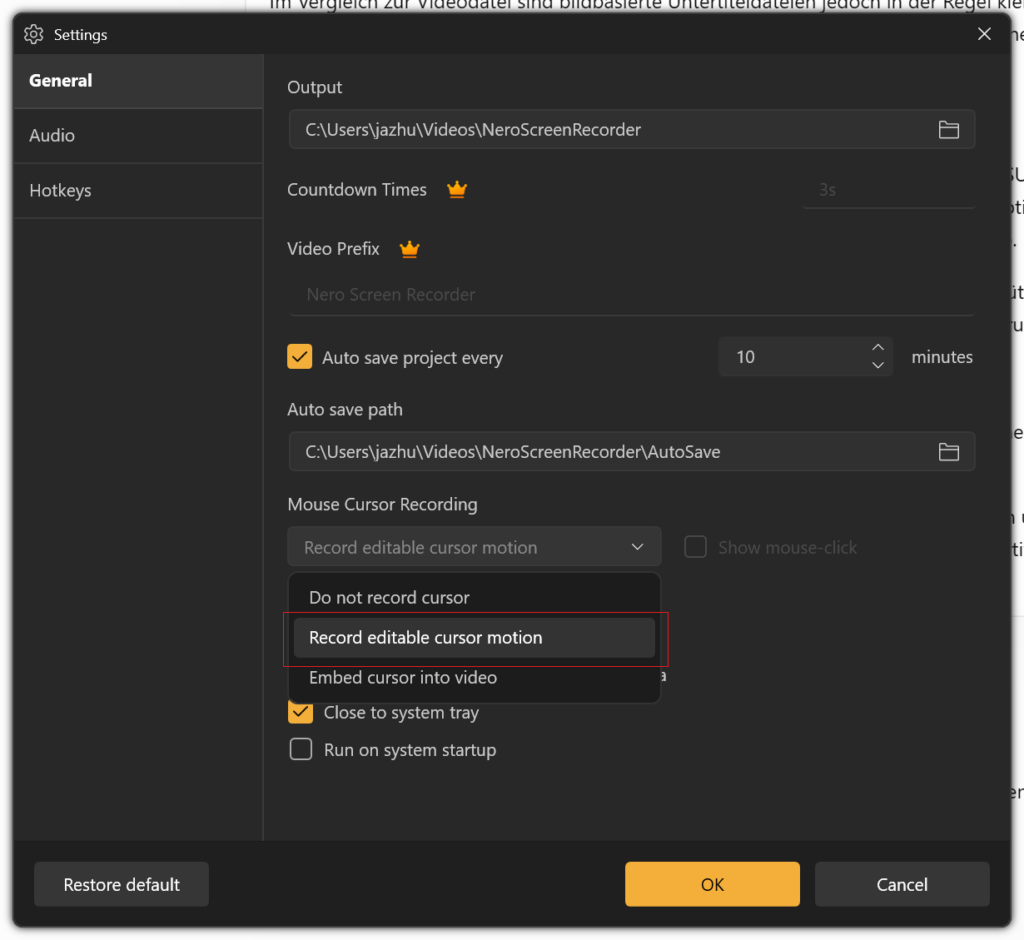
Before recording, open Settings and locate the Mouse Cursor Recording section under General.
Choose one of the available recording modes:
Do not record cursor: Excludes the mouse cursor from the recording.
Record editable cursor motion: Records the cursor movement separately so you can customize its appearance during post-production.
Embed cursor into video: Includes the cursor directly in the recorded video.
If you want to customize the cursor after recording, select Record editable cursor motion.
This option is especially useful for tutorials and demonstrations because it gives you more flexibility when editing the cursor’s appearance.
Step 2: Open the Appearance Panel
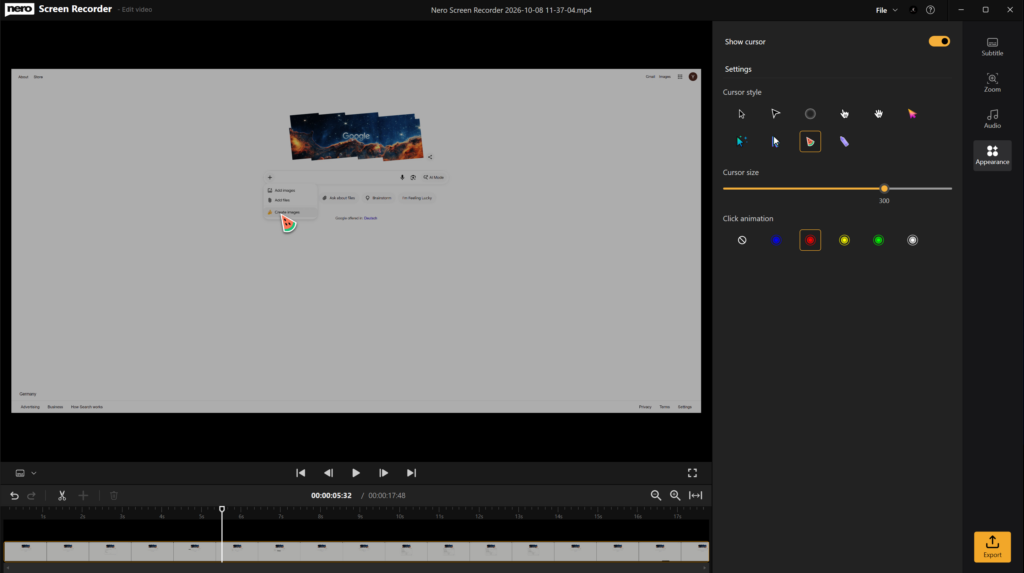
After recording, open your video in the built-in editor and select Appearance in the right-hand panel.
Enable Show cursor to display the cursor in the preview.
You can then customize its appearance using the available controls.
Step 3: Choose a Cursor Style
Under Cursor style, select the design that best fits your video.
Depending on the available options, you can choose from different pointer shapes and visual styles, including standard pointers, hand-shaped pointers, circular highlights, and colorful cursor designs.
Consider your audience and recording background when choosing a style:
Use a standard pointer for a clean, professional look.
Choose a larger or more distinctive pointer when recording detailed software tutorials.
Use a colorful cursor to make important actions easier to spot in visually complex recordings.
A consistent cursor style helps viewers follow your demonstrations without unnecessary distractions.
Step 4: Adjust the Cursor Size
Use the Cursor size slider to make the cursor larger or smaller.
A larger cursor is helpful when demonstrating small interface elements, menu options, or detailed settings. A smaller cursor may be more appropriate when you want to keep the screen uncluttered.
Preview the result and choose a size that remains easy to see without covering important interface elements.
Step 5: Add Click Animations
Nero Screen Recorder also lets you customize the visual effect shown when you click the mouse.
Under Click animation, choose the effect that best suits your recording. Available options include different colored rings and a setting that disables the click animation.
Click animations can help viewers identify important actions, especially when you are explaining a sequence of steps or demonstrating where to select a button.
For example, a colored ring around a click can draw attention to a menu selection without requiring additional annotations.
Tip: Use click animations selectively. A clear cursor and occasional click highlights usually work better than effects that distract from the content.
2. Adjust Audio Balance in the Built-in Editor
Clear visuals are only half of a good screen recording. If your system audio is too loud or your microphone narration is difficult to hear, viewers may struggle to follow your explanation.
Nero Screen Recorder 2027 lets you adjust audio levels in the built-in editor, helping you balance system sound and microphone audio after recording.
Step 1: Open the Audio Panel
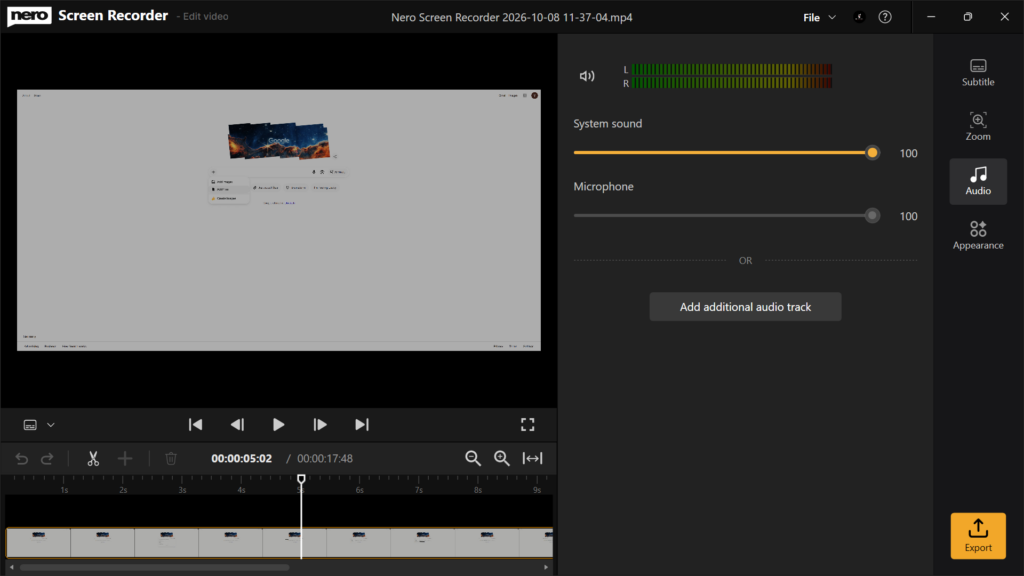
Open your recording in the editor and select Audio in the right-hand panel.
The panel displays separate controls for:
System sound: Controls the level of audio captured from your computer, such as application sounds, website audio, and other system playback.
Microphone: Controls the level of your recorded voice or other microphone input.
The level sliders let you adjust these sources independently.
Step 2: Adjust the System Sound Level
Use the System sound slider to increase or decrease the volume of your computer’s audio.
For example, if a tutorial includes background music or application sounds that overpower your narration, lower the system sound level.
If the computer audio is too quiet to hear important notifications or demonstrations, increase it as needed.
Step 3: Adjust the Microphone Level
Use the Microphone slider to control the volume of your recorded narration.
If your voice sounds too quiet compared with the system audio, increase the microphone level. If your narration is too prominent, reduce it.
The goal is to make speech easy to understand while keeping other sounds at an appropriate level.
Step 4: Find a Suitable Balance
Play the recording and listen to both audio sources together.
A useful starting point for a narrated software tutorial is to make the voice the primary audio source while keeping system sounds audible but secondary.
Adjust the two sliders until the narration and system audio work well together. The ideal settings depend on the original recording levels and the type of content.
Important: Changing a volume slider adjusts the playback level of its corresponding audio source. It does not necessarily remove background noise, repair distortion, or recover audio that was never captured.
Step 5: Add an Additional Audio Track if Needed
The Audio panel also includes an Add additional audio track option.
Use this option when you want to add another audio source to your editing workflow, such as supplementary audio for your video.
After adding a track, review the available controls and listen to the combined result to ensure the audio remains clear and balanced.
Step 6: Export Your Edited Video
Once you are satisfied with the cursor appearance and audio balance, click Export to produce your finished video.
Review the exported file to confirm that the cursor is visible as intended, click animations appear correctly, and the audio levels are suitable for your audience.
3. Create More Professional Screen Recordings
Combining mouse cursor editing with audio balancing helps you create more polished screen recordings for a variety of purposes.
Software tutorials: Make buttons, menus, and mouse clicks easier to follow.
Training videos: Help learners focus on each action while keeping spoken instructions clear.
Product demonstrations: Present interface interactions in a more visually engaging way.
Online presentations: Balance narration with application sounds or other system audio.
Instructional content: Improve accessibility and comprehension through clear visual guidance and understandable sound.
The advantage is convenience: you can refine these important details within Nero Screen Recorder’s existing editing workflow rather than relying on a separate application for every adjustment.
Frequently Asked Questions (FAQ)
1. Can I change the mouse cursor after recording?
Yes, provided you selected Record editable cursor motion in the recording settings. You can then use the editor’s Appearance panel to show or hide the cursor, choose a style, adjust its size, and configure click animations.
If you chose Embed cursor into video, the cursor is part of the recorded image and cannot be customized in the same way as a separately recorded, editable cursor.
2. What is the difference between editable cursor motion and an embedded cursor?
With editable cursor motion, the cursor is recorded separately from the screen image, allowing you to modify its appearance during post-production.
With an embedded cursor, the pointer is included directly in the video frames. Its appearance is therefore part of the image, so changing the cursor style or size independently is not available in the same way.
3. Can I hide the mouse cursor in the final video?
Yes. If your recording contains editable cursor motion, turn off Show cursor in the Appearance panel.
If the cursor was embedded directly into the video, disabling the cursor display control will not remove it from the recorded image.
4. Can I make the mouse cursor larger?
Yes. Open the Appearance panel and use the Cursor size slider to adjust the cursor size.
A larger cursor can make tutorials easier to follow, especially when viewers need to identify small buttons or interface controls.
5. What are click animations used for?
Click animations visually highlight mouse clicks so viewers can more easily identify where an action takes place.
They are particularly useful for software demonstrations and step-by-step instructions. Choose a suitable animation or disable the effect if you prefer a simpler presentation.
6. Can I adjust system sound and microphone audio separately?
Yes. In the Audio panel, the System sound and Microphone sliders control their respective audio levels independently.
This lets you reduce loud application sounds or increase quiet narration without necessarily changing the level of the other source.
7. What should I do if my voice is too quiet?
Open the Audio panel and increase the Microphone level. Then play the recording to check whether your narration is easier to hear.
If your voice was recorded at an extremely low level, increasing the volume may also make background noise more noticeable. It is best to check your microphone level before recording whenever possible.
8. Can I reduce system sounds without affecting my voice?
Yes. Lower the System sound slider while leaving the Microphone slider unchanged.
This is useful when recording tutorials that include website audio, application notifications, or other computer sounds alongside spoken explanations.
9. Does adjusting audio balance remove background noise or echo?
Not necessarily. The audio sliders adjust volume levels; they are not, by themselves, dedicated noise-removal or echo-cancellation tools.
For cleaner recordings, use a suitable microphone, minimize background noise, and check your recording environment before starting.
10. What does Add additional audio track do?
The Add additional audio track option lets you add another audio source to your editing workflow.
This can be useful when you want to supplement the original recording with additional audio. Check the controls available for the added track and preview the result before exporting.
11. Do I need a separate video editor to customize the cursor and audio levels?
For the cursor and audio adjustments described in this guide, Nero Screen Recorder provides controls in its built-in editor. You can customize an editable cursor and adjust the available audio levels before exporting your video.
More advanced editing requirements may still call for dedicated audio or video editing software.
12. Are these features available in every version of Nero Screen Recorder?
Feature availability depends on your Nero Screen Recorder edition and license. Nero Platinum Suite includes the Basic version of Nero Screen Recorder, while the Pro version is available separately. Check your edition’s feature list to confirm which tools are included.
Conclusion
Nero Screen Recorder 2027 gives you more control over two important aspects of screen recording: visual guidance and sound clarity.
With editable mouse cursor motion, customizable cursor styles, adjustable size, and click animations, you can help viewers follow your on-screen actions. With separate system sound and microphone controls, you can also create a more balanced listening experience.
Make these adjustments in the built-in editor, preview the result, and export a screen recording that is easier to watch, hear, and understand.