Wieviel Video bekomme ich auf eine DVD? Welche Einstellungen muss ich wÀhlen?

Das hÀngt zum einen vom gewÀhlten Disk-Typ ab, zum anderen von der gewÀhlten VideoqualitÀt (Datenrate).

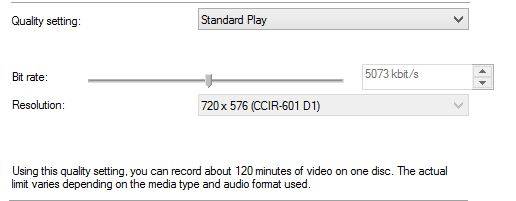
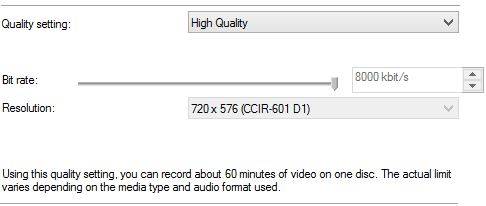
Mit StandardqualitÀt (5073 kbit/s) können Sie ca. 2 Stunden Video auf eine DVD-5 (4.38GB) brennen.DVD Set EN_1 00033Mit Hoher QualitÀt (8000 kbit/s) reduziert sich das auf der selben Disk auf eine Stunde.DVD Set EN_3 00033
Die QualitĂ€t Ihrer DVD-Video-Disk können Sie einstellen unter: ‚Optionen > Aufnahmefomat-Optionen‘.

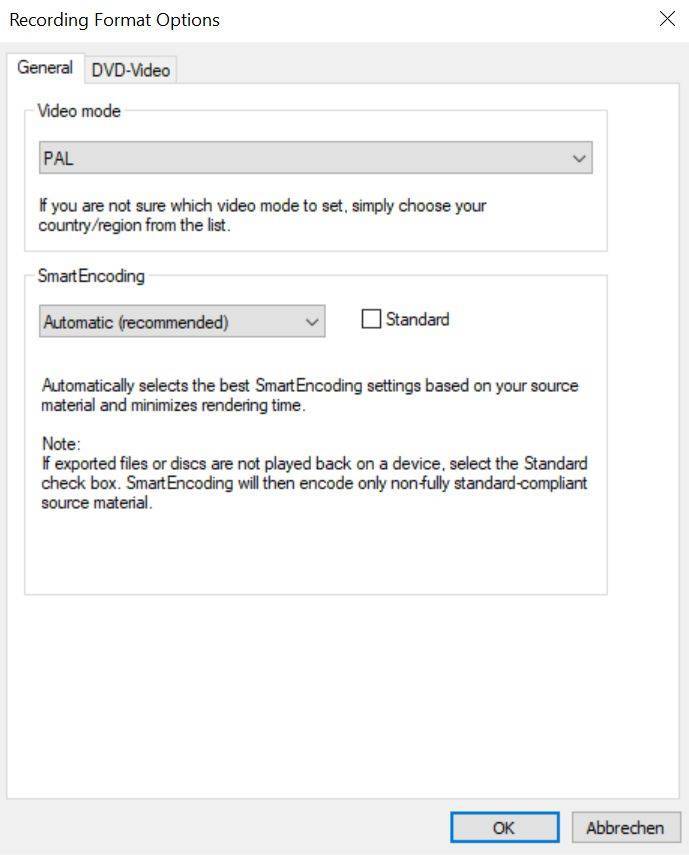
Im Reiter ‚Allgemein‘ können Sie den passenden TV-Standard unter ‚Videomodus‘ auswĂ€hlen – entweder PAL (Europa usw.) oder NTSC (Nord-Amerika usw.).  Als Grundeinstellung ist die Auswahl gekoppelt an die Sprache Ihres Betriebssystems.  ‚SmartEncoding‘ ist ebenfalls ‚automatisch‘ voreingestellt und wir empfehlen dies so zu belassen. Im Normalfall mĂŒssen Sie im Fenster ‚Allgemein‘ also nichts verĂ€ndern.

TIPP: Schauen Sie im Nero KnowHow Glossar nach und lernen Sie mehr ĂŒber PAL/NTSC und SmartEncoding.

Quality #1

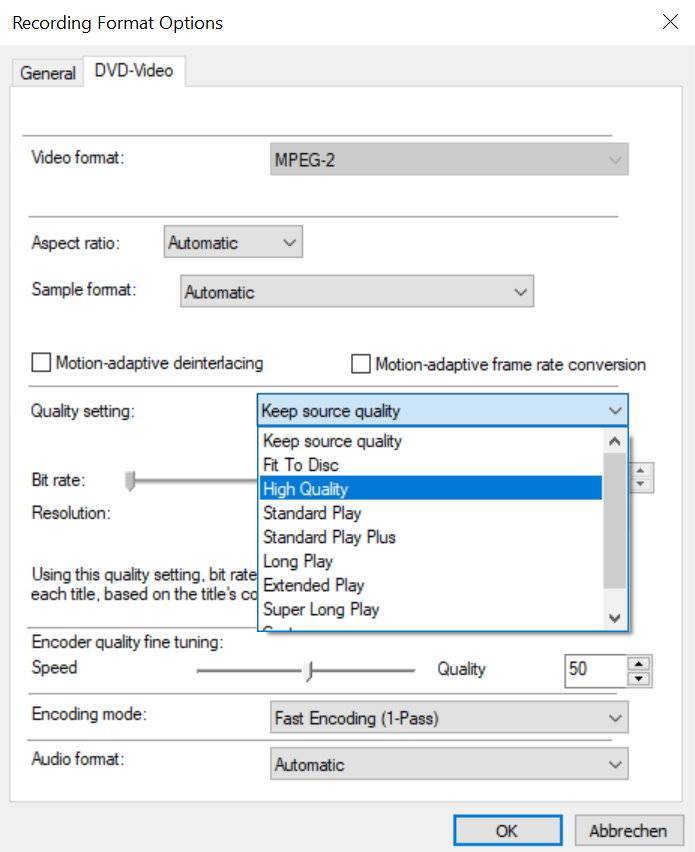
Im Reiter ‚DVD-Video‘ unter den ‚Aufnahmefomat-Optionen‘ stellen Sie die BildqulitĂ€t Ihrer DVD-Video-Disk ĂŒber ‚QualitĂ€tsteinstellungen‘ ein.

Quality #2

Sie können ‚Nero Video‘ auch so einstellen, dass die QualitĂ€t automatisch auf die GrĂ¶ĂŸe der gewĂ€hlten Disk angepasst wird, so dass Ihr Projekt auf eine Disk passt. Bei sehr viel Videomaterial auf einer Disk kann das aber zu hoher Kompression und damit zu geringer WiedergabequalitĂ€t fĂŒhren.

In einem solchen Falle empfiehlt es sich, eine ‚DVD-9 Disc‘ (Double Layer Disc mit 8.5 GB) zu verwenden. Diese wird den Speicherplatz bei den oben angegeben Werten verdoppeln.

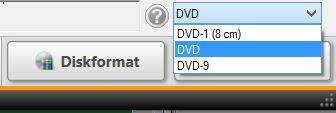
In ‚Nero Video‘ können Sie auch ganz einfach den Disk-Format-Umschalter im Inhaltsbildschirm und im Brennbildschirm verwenden.DVD Set DE_4 00034

TIPP: wenn Sie mehr zur Erstellung von DVD-Video-Disks in Nero Video erfahren wollen, schauen Sie sich NeroKnowHow 00112 an.

Nero KnowHow 00032

Schnelles oder zweifaches Enkodieren? Was ist besser?

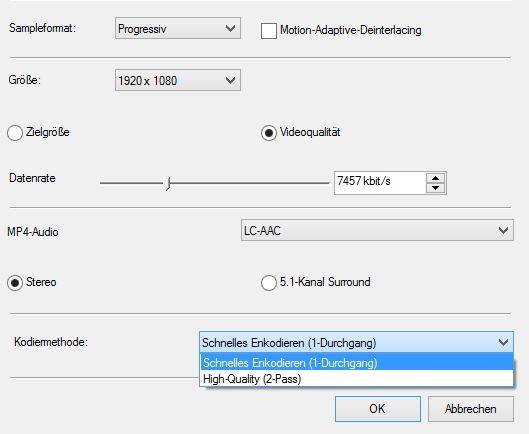
‚Nero Video‘ bietet zwei Wege, Videodateien zu enkodieren wie im Screenshot gezeigt: ‚Schnelles Enkodieren (1-Durchgang)‘ und ‚High Quality (2-Pass) – zweifaches Enkodieren‘.

1pass_DE 00038

Zweifach-Enkodieren macht dann Sinn, wenn Sie viele Effekte im Videoprojekt verwenden oder wenn Ihr Eingabeformat mit dem Ausgabeformat nicht ĂŒbereinstimmt. Bei der Ausgabe (Export) mĂŒssen solche Projekt komplett neu berechnet werden. Zweifach-Enkodieren fĂŒhrt hier einen doppelten Berechnungsvorgang durch, um auch das letzte QuĂ€ntchen QualitĂ€t aus Ihrem Projekt herauszuholen.

Wenn Eingabe- und Ausgabeformat weitgehend identisch sind, macht ein Zweifach-Enkodieren keinen Sinn. In diesem Falle verwenden Sie das schnelle Enkodieren mir einem Durchgang.

Beachten Sie auch, das Zweifach-Enkodieren die doppelte Berechnungsdauer benötigt.

DarĂŒberhinaus gibt es in ‚Nero Video‘ die Ă€ußerst nĂŒtzliche ‚Nero SmartEncoding‘-Technologie. Diese hilft Ihnen Zeit zu sparen und die OriginalqualitĂ€t zu erhalten, wenn Eingabe- und Ausgabeformat identisch sind. Sobald das SmartEncoding einsetzt, werden Dateien beim Export nicht erneut berechnet, sonderen die OriginalqualitĂ€t der Quelldatei exportiert.

Nero KnowHow 00034

Änderungsbericht – Nero Score

3.2.1.41 (1.0.22.0 Microsoft Store-Version) – HinzufĂŒgen der „RAID“-Markierung fĂŒr die Software-Modus-RAID-Festplatten

3.2.1.30 (1.0.18.0 Microsoft Store version) – UnterstĂŒtzung des Festplattengeschwindigkeitstests zum Testen der Leistung von SSD/HDD

Der Festplattentest hat zwei Modi: Schnelltest und ausfĂŒhrlicher Test.

Der Schnelltest testet nur die sequentielle Lese- und Schreibgeschwindigkeit der Festplatte, damit Sie den Unterschied zwischen der tatsĂ€chlichen Festplattengeschwindigkeit und der Nenngeschwindigkeit in der Spezifikation sowie die Leistung beim Kopieren großer Dateien von einem Ort zum anderen erkennen können.

Der ausfĂŒhrliche Test testet zusĂ€tzlich die zufĂ€llige Lese- und Schreibgeschwindigkeit, um die Leistung der Festplatte beim AusfĂŒhren von Anwendungen (z. B. Videospielen) oder beim Systemstart zu ermitteln.

Disk Score = (Sequentielles Lesen + Sequentielles Schreiben)/2 + (4K zufÀlliges Lesen + 4K zufÀlliges Schreiben)/2

3.2.1.13 – UnterstĂŒtzt die Anmeldung mit dem Nero-Account und ĂŒbermittelt den Spielstand mit Ihrem Spitznamen.

3.2.1.10 – Die Initialisierungszeit fĂŒr AVC-Codierungs- und Decodierungstests wurde entfernt, um genauere Ergebnisse zu erzielen.

3.2.1.2 – Der Metaverse-Test wurde hinzugefĂŒgt, um die 3D-Rendering-Framerate der GPU zu testen

Nero Score = (CPU-Punktzahl + GPU-Punktzahl)/2

CPU-Punktzahl = (CPU AI + CPU AVC)/2

GPU-Punktzahl = (GPU 3D + GPU AVC)/2

3.0.1.20 – AVC-Dekodierungs-/Encodierungstest fĂŒr GPU und CPU hinzugefĂŒgt

Nero Score = (CPU-Wertung + GPU-Wertung)/2

CPU-Punktzahl = (CPU AI + CPU AVC) / 2

GPU-Punktzahl = GPU AVC

1.0.0.00 – Erste Version mit CPU-basiertem AI-Inferenztest fĂŒr Foto-Tagging

Nero Score = CPU AI

Nero KnowHow 00248

Changelog – Nero AI Image Upscaler

This is the changelog for version ID starting with xx.5.x.x  

If you are running an app from the Microsoft Store whose version ID starts with 2.0.x.x, please see the changelog here. 

25.5.12.0

2023-01-13

New

setup default ai model

  • Now you can set up the default AI model in the Options.
  • Support new format .webp

25.5.11.0

2022-10-28

Improvements

  • Localizations for German


25.5.10.0

2022-10-14

New

  • Hints with gif when cursor hovers on the model.

tooltip for models

  • Show the progress status in the thumbnail list for the image under processing.

progress status

  • Support compression settings when saving results as the jpeg.

jpeg compressions

  • Keep original EXIF data in the resulting image.

Improvements

  • Better sample image with result presenting.
  • The process will not be interrupted when the PC sleep.
  • Other improvements for stability and reliability.


24.5.67.0

2022-07-04

New

  • Some example images to start with.new start with example
  • You can input images from Google Drive

open from google drive

  • AI model selection is now available. Try different models for different photos till you get a happy result.

ai models

  • You define how big the result goes. 2x, 4x or by targeted width and height values.

more scale ratio

  • More comparison views:

1on1 view

  • Compare traditional and AI results with the slide bar.

traditionalvsai

  • Batch processing is possible and up to 20 images in a row.

batch process

Improvements

  • Giant improvements in processing speed with NVIDIA GPU acceleration.
  • Save files with customized file names.


24.5.30.11

2021-12-07

Improvements

  • New icon design
  • Some improvements for photographs with faces.


24.5.30.7

2021-10-21

Improvements

  • Improved ads and Nero Market button.


24.5.30.6

2021-10-11

Features

The initial release of Nero AI Image Upscaler – use artificial intelligence to increase image resolution with enhanced sharpness and detail.

  • Upscale rate: 4x.
  • Remove noise and jpeg compression artifacts.
  • Support JPEG, and PNG.


Nero KnowHow 00251

How to Use 1001TVs to Enable the Android 13 Pixel Exclusive Features Already Today on Your Non-Pixel Phone

Tips: the latest posts has been migrated to new website: https://1001tvs.com

Have you been feeling bothered that your non-Pixel phone cannot follow the Google update closely to experience the latest Android 13 new features? Do you know that you actually can easily enjoy the new Android 13 Pixel exclusive features by using the 1001TVs? This blog will show how you can use 1001TVs as your reachable access to help you enjoy the Android 13 Pixel exclusive feature without waiting.

1.Android 13 Overview— things you need to know

Android 13 tiramisu

On June 9th, Google released Android 13 Beta 3 and announced that it has reached the „platform stability“ status. This indicates that Google has locked down the main updates for Android 13.

According to Google’s schedule, Android 13’s final release will be unveiled sometime in Q3 2022.

Android 13 timeline

The release timeline for Android 13. Source: Google.

In the Beta 3 version, all application-oriented behavior and APIs are in their final version. For developers, this means that apps can be prepared for launch. For users, it means that there won’t be many changes after that from a feature or user interface change perspective.

Android 13 brings privacy features like new notification permissions and the photo picker, as well as productivity features like themed App icons, HDR video, Bluetooth LE Audio, and MIDI 2.0 support via USB, etc.

2.A new feature of Android 13— Tap to Transfer

In addition to the new features mentioned above, reportedly, there is also a possible new Android 13 feature called the “Tap to Transfer” system. It appears to be focused on transferring media controls between devices.

For example, users could theoretically start a playlist on their phone and then pass it to another phone, passing control from one’s phone to the smart speaker, tablet, TV, or any other smart device.

According to the media sources, this “Tap to Transfer” feature will display chip notifications with some contextually useful information when a user is playing media on a local media cast sender device (e.g., your Android phone), and it gets close enough to a media cast receiver device. As we can read in the now released pictures, the first part of this feature is to put a message telling users to “move closer” to the device they want to transfer media to, and then it shows a message while connecting to that other device. After connecting, the message changes to include an “undo” button to bring playback back to your device. The avatar icon seen on the message in the screenshots below will instead show the App being used when the functionality is adequately used.

9to5 Google screenshot

screenshots from 9to5google, Here’s what Android 13’s ‘Tap to Transfer’ feature looks like

Android police screenshot

screenshots from Android Police, Android 13: Everything we know about Google’s next big release

So far, we’ve only got our hands on some non-functional demo process created by Google, and the new feature right now can only be experienced in those devices that qualify for the Android 13 Beta program, and still appears to be in development. So, is there any chance for those who are not able to implement this feature? In other words, how can I get the Pixel exclusive feature on my phone?

The answer is yes! You definitely can! By using 1001TVs, all models of Android phones can easily transfer media between different devices.

3.Try the Streaming function of 1001 TVs

For the non-Pixel phones, enjoying the experience of media files traveling between different terminals is also possible. For instance, we can use 1001TVs to stream media files from your phone to smart TV.

Step 1: Open “1001 TVs” and enter the “Streaming” page.

streaming step 1

Then you can choose to mirror Photo, Video, or Music.

Mirror Photo – Tap the Play button to automatically play the next photo. Modify the picture play interval on the Settings page.

Mirror Video – Long press to select multiple videos, automatically play the next selected video, and support mirroring sound.

Mirror Music – Support for sound mirroring.

Step 2: Select the media file you want to play on your phone (e.g. a piece of music), then select the target smart TV you need to connect to from the list of devices.streaming step 2

Since most smart TV and TV boxes currently on the market support the DLNA protocol, once it connected to the same network with the phone, they can be reached automatically.

After successfully connecting, you can enjoy the streaming media files from your phone on the smart TV terminal, and you can synchronize the control on your phone for both devices!

streaming music success image-1


1001TVs is open to users of any operating system, you are highly welcome to download the 1001TVs on your no-Pixel phone or any other smart device.  Plus, if you have further interest, you can also visit Nero’s official website for a deeper and multi-dimensional software experience with our products!